On this page
The UAE Federal Tax Authority is rolling out mandatory e-invoicing in phases, beginning with larger enterprises and expanding progressively to smaller businesses. Phase 1 targets large and listed companies, with Phase 2 extending requirements to medium-sized businesses, and Phase 3 capturing the remainder of the taxable business population. Every business in scope must transmit invoices in the PINT-AE format through an accredited Access Service Provider. The critical operational detail most businesses miss: your invoice data must be validated and correctly mapped to PINT-AE structure before it reaches your ASP, not after. A submission that fails ASP validation counts as a non-submission for compliance purposes. That single fact determines whether your internal systems need a middleware layer or whether a direct ERP plugin is sufficient for your situation.
What the FTA E-Invoicing Mandate Actually Requires
The UAE e-invoicing framework is built on the Peppol network and uses the PINT-AE (Peppol International Invoice for the Arabian Emirates) standard. Every tax invoice and credit note must be structured according to this specification and transmitted through a licensed Access Service Provider before it is considered legally issued.
The mandate is not simply about sending invoices electronically. It requires a specific, machine-readable data structure that your existing ERP or accounting system almost certainly does not produce by default.
The Federal Tax Authority oversees the rollout, and businesses that miss their phase deadline face non-compliance exposure from that point forward. The FTA has made clear that the ASP acts as the gatekeeper: if the invoice structure is wrong when it arrives at the ASP, the invoice does not proceed, and the fault sits with the issuing business, not the ASP.
The Three-Phase Rollout Structure
The FTA is phasing the mandate by business size, using annual revenue thresholds to determine which cohort a business falls into and when it must be fully compliant.
- Phase 1 covers large businesses, generally those with revenues above AED 150 million. These businesses are the earliest adopters and face the most immediate compliance deadlines.
- Phase 2 extends to medium-sized businesses, broadly those with revenues above AED 37.5 million. This cohort has a later go-live date, but the implementation timeline is short enough that preparation must begin now.
- Phase 3 captures the remaining taxable businesses below those thresholds. Exact dates for later phases are subject to FTA confirmation, but the direction is clear: full market coverage is the end state.
For businesses that operate across multiple entities or revenue bands, the phasing can apply differently to different legal entities within the same group, which creates a coordination challenge that many finance teams underestimate.
Why the PINT-AE Structure Is the Actual Compliance Problem
Most businesses spend their planning time thinking about deadlines. The harder operational problem is the data structure itself.
PINT-AE is a specific XML schema derived from the global Peppol BIS Billing 3.0 standard, adapted for UAE VAT requirements. It mandates precise field mappings, coded values for things like tax categories and payment terms, and a defined document lifecycle that includes credit notes as first-class objects, not afterthoughts.
Your ERP or accounting system exports data in its own format: SAP IDocs, Oracle UBL variants, QuickBooks exports, Zoho CSV files. None of these are PINT-AE natively, and none will be.
This is the gap that causes failures at the ASP level. An invoice that looks complete in your finance system can still be rejected because a mandatory PINT-AE field is absent, a code list value is incorrect, or a credit note reference is malformed. When that rejection happens, most businesses only see a generic failure status from their ASP, with no clear indication of which field failed or why.
Kodowo's validation layer runs every invoice through PINT-AE rules before it ever reaches the ASP. When something fails, the platform surfaces the specific reason rather than a generic error state, so the finance team can correct and resubmit without digging through XML or contacting ASP support. You can review the full lifecycle tracking approach on the Kodowo platform page.
What an ERP-Agnostic Middleware Layer Actually Does
A single-ERP plugin solves part of the problem for businesses running exactly one ERP, with no legacy data, no spreadsheet-based processes, and no subsidiary systems. Most real businesses do not fit that profile.
An ERP-agnostic middleware layer accepts invoice data in whatever format your systems produce: API call, CSV, XLSX, or JSON. It normalizes everything into a single internal schema, validates that schema against PINT-AE rules, maps the validated data to the exact structure your accredited ASP requires, and then hands it off. The entire chain is logged to an append-only audit trail, which matters both for internal review and for FTA audit response.
The practical result is that your ERP integration work happens once, at the middleware boundary, rather than being renegotiated every time a field changes in the PINT-AE specification or your ASP updates its submission requirements.
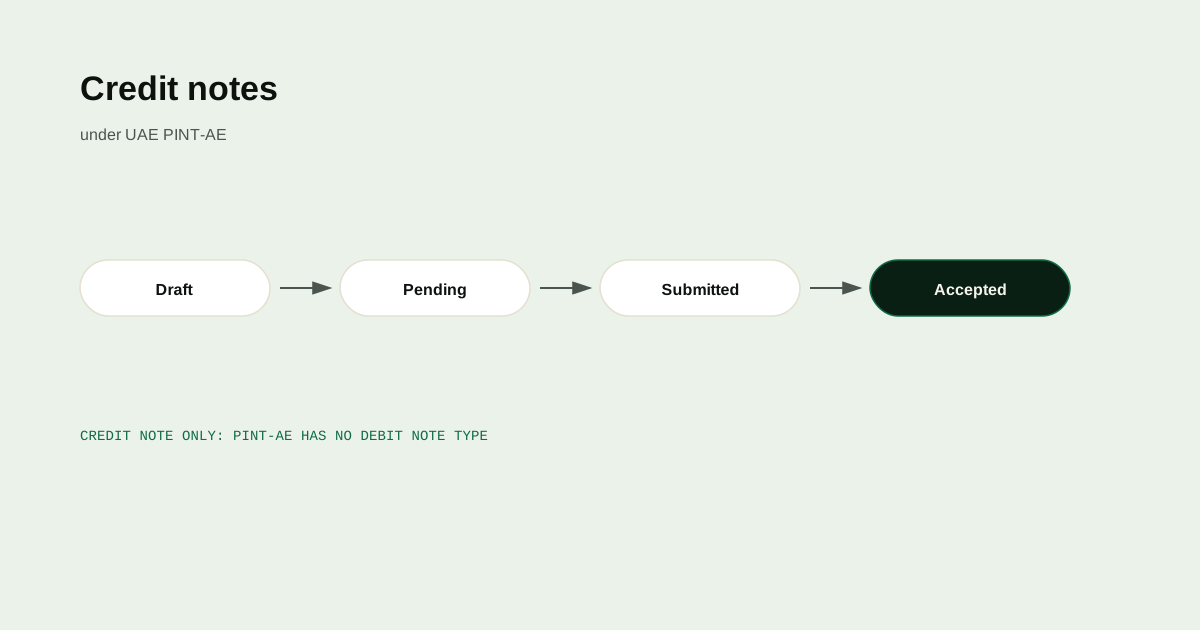
Credit notes follow the same pipeline. They move through a complete lifecycle from draft to submission to acceptance, and they can be cancelled before transmission if an error is caught. This is relevant to the FTA mandate because credit notes are subject to the same structural requirements as invoices, and businesses that handle them as a separate, manual process create a separate compliance gap.
For finance teams specifically, the practical benefit is that every invoice has a real, visible status: received, validated, submitted, cleared, or failed with a specific reason. There is no black box between your accounting system and the FTA network. The Finance and Tax solutions page covers how this maps to AR and AP team workflows in more detail.
What Your Business Should Be Doing Right Now
If your revenue puts you in Phase 1 or Phase 2, the window for relaxed planning has already closed. Implementation work, including ASP selection, ERP integration, and validation testing, typically takes longer than finance teams expect because the technical work surfaces data quality issues that have existed for years but were never visible until a machine tried to structure them.
Specific steps worth taking immediately:
- Confirm your phase assignment. Use your most recent annual revenue figure against the FTA thresholds. If you operate multiple legal entities, check each one separately.
- Audit your invoice data quality. Run a sample of recent invoices through PINT-AE validation before you commit to an integration approach. The failure rate on first-pass validation is consistently higher than finance teams expect.
- Select an accredited ASP. The FTA publishes a list of accredited Access Service Providers. Your ASP choice affects the submission format your middleware must produce, so this decision has technical downstream consequences.
- Build in a testing period. PINT-AE validation errors in production are compliance events. Testing with real invoice data, not synthetic samples, catches the field-mapping problems that only appear with actual transaction volumes.
Businesses that treat e-invoicing as a technology project rather than a compliance deadline tend to discover their data quality problems at the worst possible moment: during live submission under a deadline.
If you are not certain where your current systems stand against PINT-AE requirements, Kodowo's readiness check is a direct way to find out before the ASP handoff becomes the moment of truth.
The Audit Trail Requirement Is Not Optional
One aspect of the FTA mandate that receives less attention than the submission requirements is the audit trail obligation. Businesses must be able to demonstrate, on request, the full lifecycle of every invoice: when it was issued, what its status was at each stage, and whether any changes were made before or after submission.
An append-only audit trail satisfies this requirement by design. Every status change and every account action is recorded in sequence and cannot be altered retroactively. For businesses that currently manage invoice records in spreadsheets or within an ERP that allows record editing, this represents a genuine process change, not just a software upgrade.
The FTA audit exposure from a missing or incomplete invoice trail is separate from the exposure created by a missed submission, meaning a business can be non-compliant on two dimensions simultaneously without realizing it.
Multi-entity businesses face an additional layer here: row-level tenant isolation ensures that invoice records and audit trails for separate legal entities remain isolated from each other, which matters both for audit response and for internal governance.
Frequently asked questions
- Which phase of the UAE FTA e-invoicing mandate applies to my business?
- Phase assignment is based on annual revenue. Businesses with revenues above AED 150 million fall into Phase 1, those above AED 37.5 million fall into Phase 2, and the remaining taxable businesses will be covered in Phase 3. If you operate multiple legal entities, check each entity's revenue separately, as different entities within the same group can fall into different phases.
- What is PINT-AE and why does my ERP not already produce it?
- PINT-AE is the specific XML invoice structure required by the UAE FTA, derived from the global Peppol BIS Billing 3.0 standard and adapted for UAE VAT rules. ERP and accounting systems produce their own native export formats, such as IDocs, UBL variants, or CSV files, none of which map directly to PINT-AE without a normalization and validation step between your system and your accredited ASP.
- What happens if an invoice fails validation at the ASP level?
- A failed ASP submission is treated as a non-submission for compliance purposes, meaning the invoice is not legally issued until a corrected version is successfully transmitted. Most ASPs return a failure status without specifying which PINT-AE field caused the rejection, which is why pre-submission validation at the middleware layer matters: it catches and explains failures before they become compliance events.
- Do credit notes fall under the same e-invoicing requirements as invoices?
- Yes. Credit notes are subject to the same PINT-AE structural requirements as tax invoices and must be transmitted through your accredited ASP. They follow a defined lifecycle from draft through submission and acceptance, and a malformed credit note reference is a common source of PINT-AE validation failures for businesses that handle credit notes as a manual, separate process.