On this page
PINT-AE stands for Peppol International (PINT) Billing specification, UAE edition. It is the structured XML invoice format mandated by the UAE Federal Tax Authority for electronic invoice exchange. Every invoice transmitted through the UAE e-invoicing network must conform to this schema exactly, validated field by field, before it reaches an accredited Access Service Provider (ASP) for onward delivery. The format defines which fields are mandatory, how tax amounts must be expressed, how credit notes must be structured, and dozens of other rules that a plain PDF or a standard ERP export simply does not satisfy. The core problem is straightforward: your ERP or accounting system was built to produce invoices in its own proprietary format, and no major platform, whether SAP, Oracle, Microsoft Dynamics, or a regional accounting tool, outputs PINT-AE natively. Something has to bridge that gap before transmission.
What PINT-AE Actually Is
PINT-AE is the UAE's national adaptation of the Peppol billing standard. Peppol is an international e-procurement framework originally developed in Europe and now adopted across Asia-Pacific and the Middle East as the basis for cross-border and domestic e-invoicing. The UAE Federal Tax Authority selected the PINT billing specification as the foundation for its mandatory e-invoicing rollout, then layered UAE-specific rules on top, covering VAT treatment, Arabic character support, currency requirements, and additional mandatory fields relevant to UAE commercial law.
The result is a schema with strict, machine-readable rules that leave no room for approximation. Each invoice must be an XML document structured according to the PINT-AE specification, with defined code lists for item classifications, tax categories, and currency identifiers. A missing mandatory element, a wrong data type, or a value outside an approved code list causes the invoice to be rejected. There is no grace period or partial acceptance.
Why Your ERP Cannot Produce It Natively
This is the question most finance and IT teams hit first, and the answer is structural, not a matter of software quality.
ERP systems and accounting platforms store invoice data in their own internal schemas, optimized for their own workflows, reporting, and integrations. When they export or transmit invoice data, they produce output in formats they were designed around: proprietary XML dialects, flat CSV files, PDF documents, or formats aligned with older regional standards. SAP, for example, has its own iDoc and IDOC-XML structures. Oracle has its own output formats tied to its Financials cloud. QuickBooks and Xero export data in their own API schemas.
None of these map directly to PINT-AE, because PINT-AE did not exist when these systems were built, and most vendors have not retrofitted native PINT-AE output into their core product. Even where a vendor offers a localization pack or a regional compliance module, those additions address tax calculation and reporting inside the ERP, not the structural transformation of outbound invoice data into a schema an ASP can accept and validate.
The transformation problem has several layers. First, field names differ. What your ERP calls a "customer reference" may need to map to a specific PINT-AE element with a different label and a constrained value format. Second, code lists differ. PINT-AE requires specific UN/CEFACT unit codes, ISO 4217 currency codes, and UAE-specific tax category identifiers. Your ERP may store equivalent data in its own internal codes that have no automatic relationship to those required values. Third, structure differs. PINT-AE is hierarchical in a specific way, with invoice lines, tax totals, and allowances expressed in a defined nesting order. Flattening or restructuring that from a different source format is a non-trivial mapping exercise.
A plugin built for a single ERP can solve this for that one platform, but only for that platform. A business running two ERPs, or one that has recently migrated, or one that operates different systems across subsidiaries, faces the same gap the moment the plugin's scope runs out.
What Has to Happen Between Your ERP and Your ASP
The UAE e-invoicing model requires businesses to submit invoices through an accredited Access Service Provider, a certified intermediary that handles the secure transmission to the FTA's network. The ASP expects to receive a valid PINT-AE document. It does not perform the transformation from your ERP's native format. That work happens before the ASP ever sees the invoice.
The steps that need to occur are, in order: ingestion of the invoice data from your source system, normalization into a consistent internal schema, validation against the PINT-AE rules, mapping into the final PINT-AE XML structure, and then handoff to the ASP. If validation fails at step three, the invoice should not proceed. If it does proceed and is rejected by the ASP or the FTA network, you need to know the specific reason, not a generic failure state.
This is exactly the sequence a middleware layer handles, sitting between your ERP and your ASP rather than replacing either one. Kodowo's platform ingests invoice data via API, CSV, XLSX, or JSON regardless of which ERP it came from, normalizes everything into one canonical schema, validates and maps to PINT-AE, and hands off to your accredited ASP. Every status change from received through cleared is tracked, and failures surface the actual rejection reason so your team can act on it immediately rather than guessing.
The Audit Trail Requirement You Cannot Overlook
Compliance with UAE e-invoicing is not just about transmission. The FTA requires businesses to maintain records of their invoicing activity in a way that can be reviewed during an audit. That means every invoice, every status change, and every submission attempt needs to be logged in a way that is tamper-evident and retrievable.
An append-only audit trail, where every action is recorded and nothing can be silently modified, is the standard that satisfies FTA audit requirements. Kodowo's platform records every status change and account action in exactly this way, which means the audit trail is built as invoices move through their lifecycle rather than assembled retroactively when an audit request arrives.
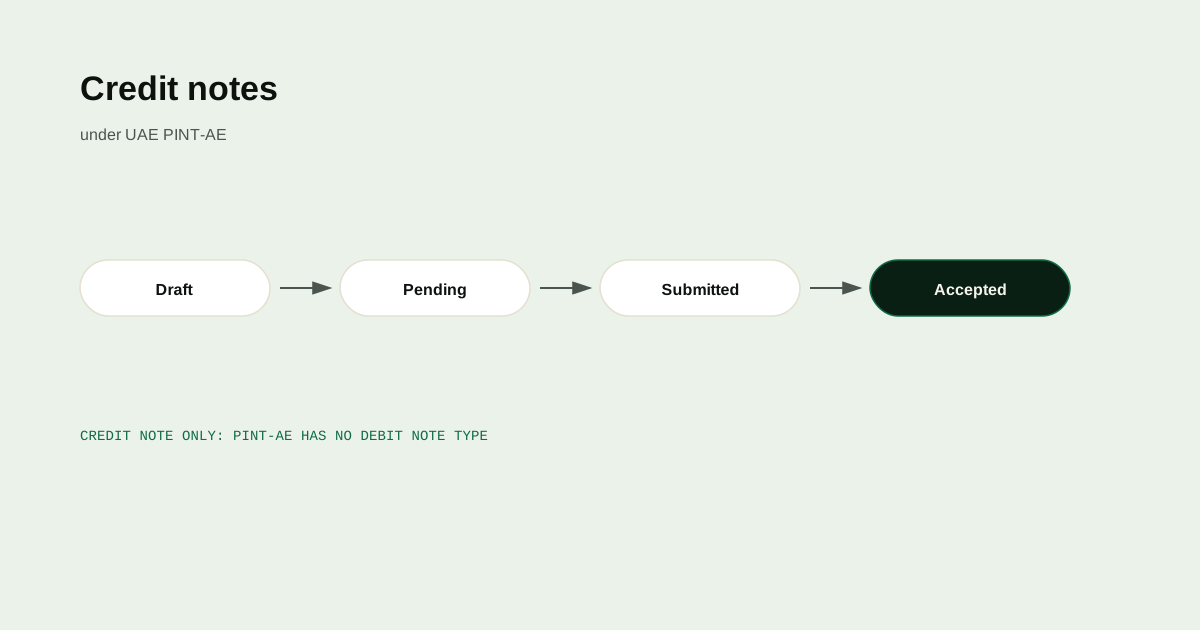
Credit notes follow the same principle. A credit note has its own lifecycle from draft through submission and acceptance, and it must be cancellable before it goes out. The same validation and mapping that applies to a standard invoice applies to a credit note, because the PINT-AE specification covers both.
Why a Single-ERP Plugin Is the Wrong Architecture
The plugin approach is appealing because it feels like a contained solution. Install a module, configure your ERP, and invoices go out. The problem is that it works only for the ERP it was built for, only for the version of the PINT-AE specification it was written against, and only until the specification updates.
When the FTA updates the PINT-AE schema, every ERP plugin needs its own update. When a business adds a second ERP or migrates to a new accounting system, the plugin coverage breaks. When a business has entities across different software environments, each entity needs its own plugin and its own configuration.
A middleware layer that is ERP-agnostic by design does not have this fragility. It accepts data from any source, applies the PINT-AE rules centrally, and hands off to any accredited ASP. When the specification changes, the change is made once in the middleware, and every connected ERP benefits automatically. This is the reason the why middleware argument is not just a marketing position: it reflects a real architectural difference in how compliance risk is distributed across a technology stack.
For businesses running multiple systems, operating across subsidiaries, or planning an ERP migration, the middleware approach is the only one that does not require re-solving the same compliance problem for each system separately.
What This Means Practically for Your Finance Team
For AR and AP teams, the practical consequence of PINT-AE is that invoices your ERP has always sent as PDFs or proprietary exports now need to leave your system as structured, validated XML documents. That process should be invisible to the people processing invoices. They should not need to understand XML schema validation or PINT-AE field mappings. They should see a clear status: the invoice was received, it passed validation, it was submitted to the ASP, and it cleared. If something went wrong, they should see exactly what went wrong and why.
The alternative, where a rejected invoice returns only a generic error code, means your finance team spends time diagnosing technical failures rather than processing invoices. At scale, that is a material operational cost on top of the compliance risk.
For IT and ERP administrators, the integration question is the one that matters most. A middleware platform that accepts API, CSV, XLSX, and JSON inputs can be connected to virtually any ERP without requiring changes to the ERP itself. The source system keeps doing what it does. The middleware handles the transformation. The developer resources and API integration support exist precisely to make that connection straightforward for the teams responsible for it.
Frequently asked questions
- What is PINT-AE in UAE e-invoicing?
- PINT-AE is the UAE's mandatory structured XML invoice format, based on the international Peppol billing specification with UAE-specific rules added by the Federal Tax Authority. Every invoice submitted through the UAE e-invoicing network must conform to this schema before it reaches an accredited Access Service Provider.
- Can my ERP send invoices directly in PINT-AE format?
- No major ERP or accounting platform produces valid PINT-AE output natively. Systems like SAP, Oracle, and Xero each have their own internal data formats and export schemas, none of which map directly to PINT-AE without transformation. A middleware layer is required to normalize and map your ERP's output before transmission.
- What is an accredited Access Service Provider and how does it relate to PINT-AE?
- An accredited Access Service Provider is a certified intermediary that receives your e-invoices and transmits them securely to the UAE FTA's network. The ASP expects to receive a valid, already-validated PINT-AE document. It does not transform your ERP's native data, so the PINT-AE mapping must happen before the invoice reaches the ASP.
- Why does PINT-AE compliance require an audit trail?
- The UAE Federal Tax Authority requires businesses to maintain tamper-evident records of invoicing activity that can be reviewed during an FTA audit. An append-only audit trail, where every invoice status change and submission attempt is logged and cannot be silently modified, is the standard approach for satisfying this requirement.